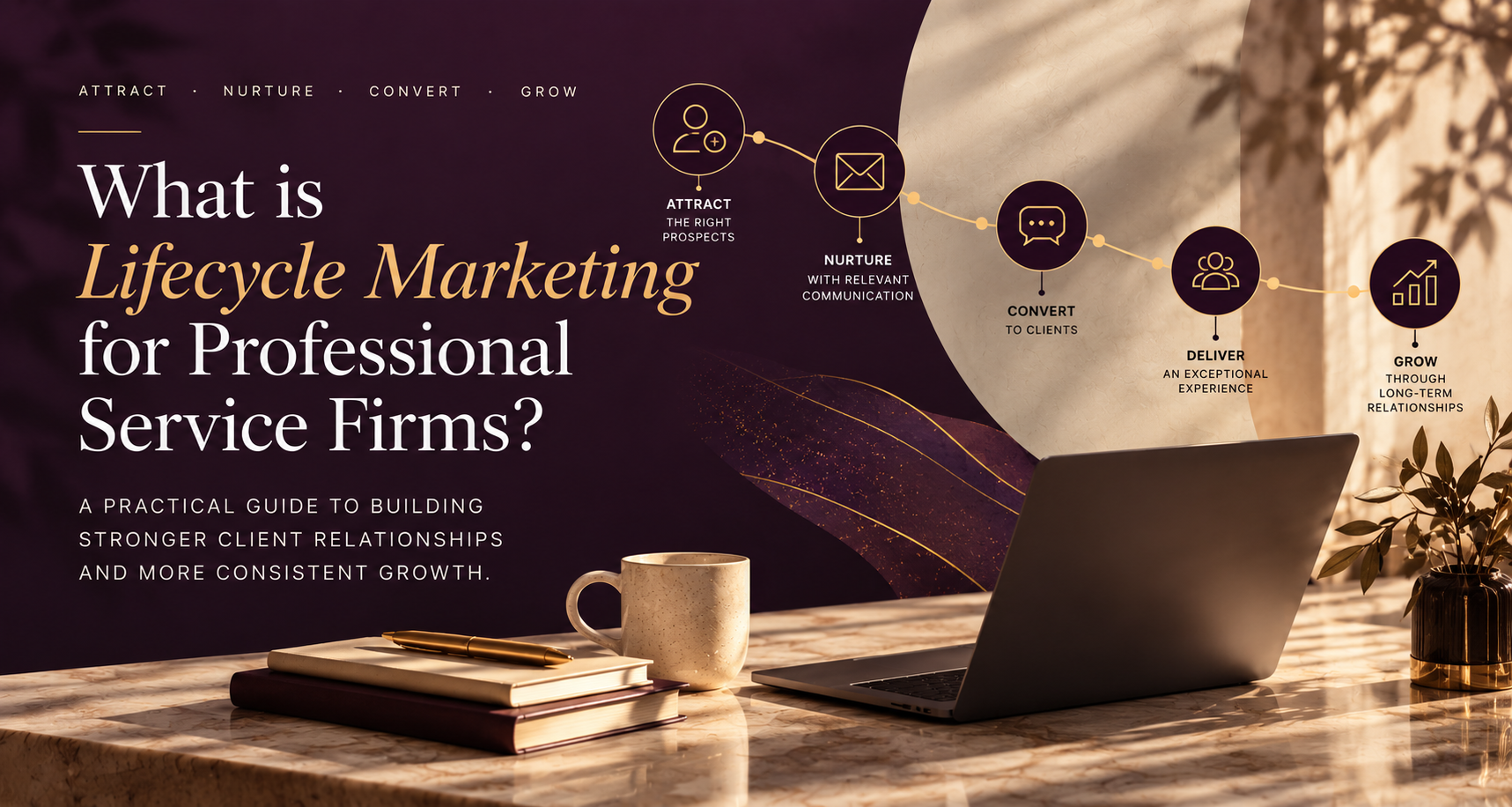
Lifecycle marketing for professional service firms is the process of guiding a prospect or client through each stage of their relationship with the business, from first discovery to inquiry, follow-up, onboarding, ongoing communication, repeat business, and referral. It connects your website, CRM, email marketing, automation, and human follow-up so the experience feels consistent instead of fragmented.
For firms that sell expertise rather than simple products, that matters because clients rarely make a decision after one visit, one email, or one conversation.
Why does lifecycle marketing matter more for professional services?
Professional services are built on trust.
A potential client may be choosing an accountant, consultant, IT provider, legal professional, advisor, agency, or another expert who will become closely involved in their business.
That decision usually takes time.
Someone may:
- Find you through Google
- Visit your website
- Read two or three service pages
- Follow your LinkedIn content
- Submit an inquiry
- Have a consultation
- Compare another provider
- Wait for internal approval
- Come back several weeks later
If your marketing only focuses on generating the initial inquiry, a large part of that buying journey is being left to chance.
Lifecycle marketing looks at the entire relationship.
The goal is not to send more emails.
The goal is to make sure the right thing happens next.
What stages are included in lifecycle marketing?
For a professional service firm, the lifecycle may look something like this:
Awareness → Consideration → Inquiry → Qualification → Sales Conversation → Client → Retention → Expansion → Referral
Each stage has a different purpose.
A person who has just discovered your firm does not need the same communication as someone who has already received a proposal.
A new client needs something different from a long-term client.
A past client may need something different again.
Lifecycle marketing helps you define those differences instead of treating everyone in your database the same.
Awareness
At this stage, someone is becoming aware of your firm.
They may find you through:
- Search
- A referral
- An article
- A webinar
- Paid advertising
- Another professional
Your job here is not necessarily to sell immediately.
You need to help them understand:
What do you do?
Who do you help?
What problem do you solve?
Consideration
Now they are actively learning more.
They may visit your service pages, read articles, review testimonials, or compare your firm with another provider.
This is where your website, positioning, proof, and educational content matter.
Inquiry
The person takes an action.
They submit a form.
Book a consultation.
Reply to an email.
Or ask for more information.
This is where many businesses assume the marketing job is finished.
In reality, this is where the operational side of lifecycle marketing becomes very important.
Qualification
Not every inquiry is automatically a good opportunity.
The business needs to understand:
- What they need
- Whether the service is a fit
- Their timing
- Their budget
- Who is involved in the decision
- What should happen next
This information should ideally be captured in your CRM rather than living only in someone’s inbox or memory.
Sales conversation
At this point, the person is actively speaking with your team.
Marketing communication may need to change.
For example, someone already discussing a proposal probably should not keep receiving generic emails telling them to book their first call.
Client
Once the person becomes a client, the relationship changes again.
They should move out of prospect-focused communication and into client onboarding.
Retention and expansion
For many professional service firms, the relationship should not end once the initial project or engagement is complete.
There may be opportunities for:
- Renewals
- Ongoing support
- Additional services
- Reviews
- Referrals
- Future projects
Lifecycle marketing helps you plan those stages too.
What does lifecycle marketing look like in practice?
Imagine a consulting firm gets a new inquiry through its website.
Without a lifecycle system, this could happen:
The form submission goes to an inbox.
Someone reads it later.
They reply manually.
The prospect may or may not get added to the CRM.
If they are not ready to move forward immediately, there may be no follow-up beyond one or two emails.
A few weeks later, the lead is forgotten.
Now compare that with a more connected lifecycle.
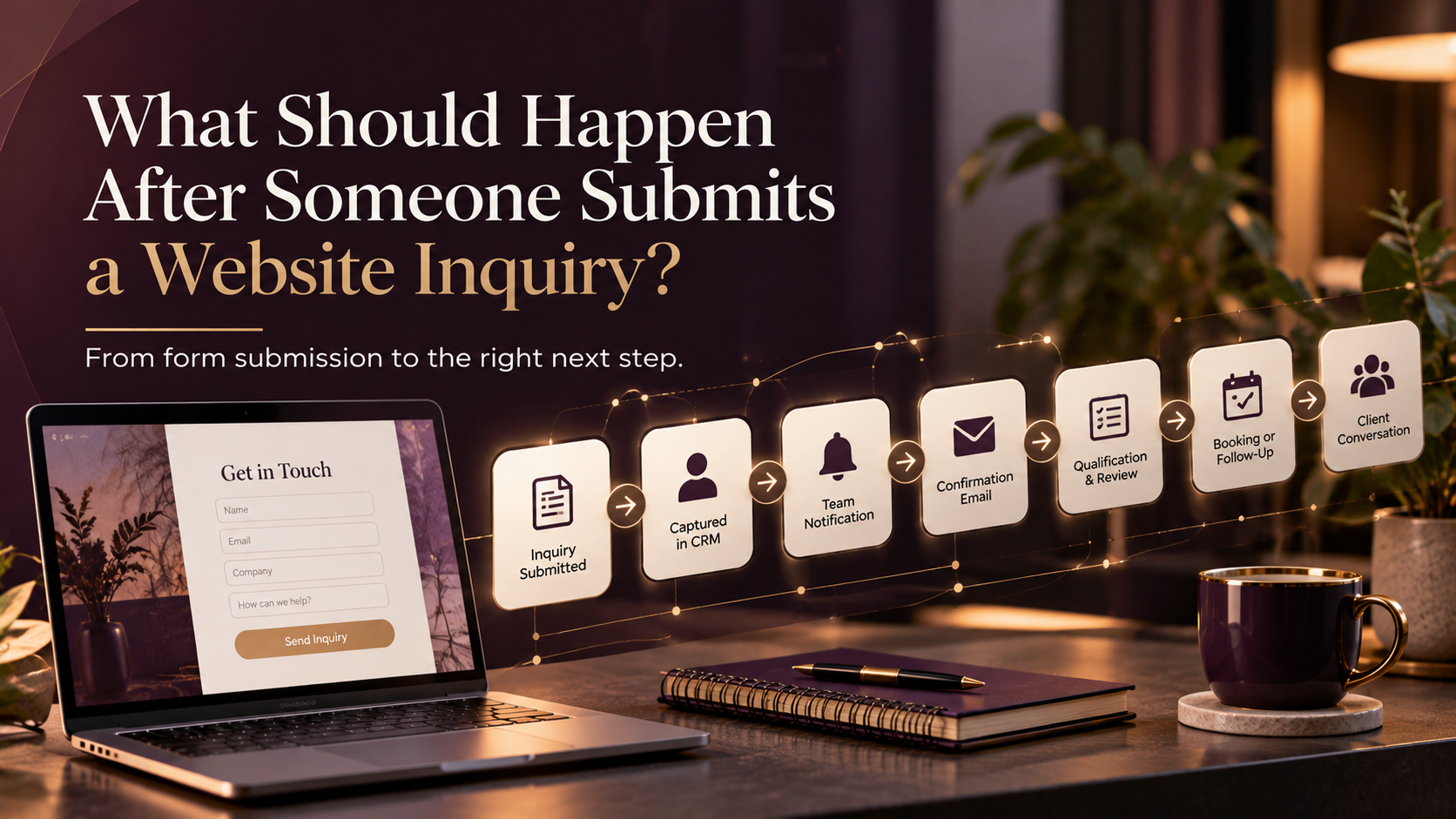
The inquiry is submitted.
The CRM creates or updates the contact.
The source and service interest are recorded.
The right person is notified.
The prospect immediately receives confirmation explaining what happens next.
A consultation is booked.
The CRM updates the lifecycle stage.
The prospect enters the appropriate follow-up process.
Once a sales conversation becomes active, generic nurture emails stop.
If the opportunity closes, the client automatically moves into onboarding.
The business does not have to manually remember every single step.
That is lifecycle marketing in practice.
It is not one giant workflow.
It is a series of connected decisions.
How does a professional services website support lifecycle marketing?
Your website is often where the lifecycle begins.
A good professional services website should make four things clear:
- Who you help
- What you help them with
- Why they should trust you
- What they should do next
That fourth point is especially important.
A website should not just exist to look professional.
It should help people move into the next appropriate stage of the relationship.
That could mean:
- Booking a consultation
- Submitting an inquiry
- Downloading a resource
- Joining an email list
- Reading a related article
- Viewing another service
The website should also connect properly to whatever happens after that action.
For example, if someone submits an inquiry, your form should ideally feed useful data into the CRM instead of simply sending an email notification.
That gives the rest of your system more context.
What role does the CRM play?
Your CRM should act as the memory of the client relationship.
It should help answer questions such as:
- Who is this person?
- What company are they from?
- How did they find us?
- What service are they interested in?
- What stage are they in?
- Has sales already contacted them?
- What emails have they received?
- Have they booked a consultation?
- Are they already a client?
Without that context, automation becomes much less useful.
For example:
If someone becomes a client but their lifecycle stage never changes, they may continue receiving prospect emails.
If someone is actively speaking with sales but the CRM does not reflect that, marketing automation may keep pushing them toward actions they have already taken.
Good lifecycle marketing depends on good CRM structure.
How does email marketing fit into lifecycle marketing?
Email is one part of the lifecycle.
It is not the entire lifecycle.
Professional service firms can use email at different stages for very different purposes.
Inquiry confirmation
Let someone know you received their message.
Explain what happens next.
Set expectations.
Lead nurture
Stay useful to prospects who are interested but not ready.
This could include:
- Educational articles
- Common mistakes
- Process explanations
- FAQs
- Relevant examples
- Case studies
Appointment communication
Send reminders and useful preparation information before a consultation.
Proposal follow-up
Keep the conversation moving without relying entirely on someone remembering to follow up manually.
Client onboarding
Send next steps, forms, resources, timelines, or instructions.
Ongoing client communication
Share important updates, resources, educational material, or relevant services.
Re-engagement
Reconnect with past prospects or clients when the context makes sense.
The important part is relevance.
The email should match where the person currently is in the relationship.
Does lifecycle marketing require complicated automation?
No.
In fact, I would usually recommend starting small.
A professional services firm does not need 40 workflows to benefit from lifecycle marketing.
I would first look at the places where opportunities are most likely to fall through the cracks.
For many firms, those are:
1. Website inquiry follow-up
What happens immediately after someone reaches out?
2. Lead qualification
How is the opportunity assessed and organized?
3. Follow-up for leads who are not ready
What happens when someone says:
“Maybe later.”
4. Client onboarding
What happens between:
“Yes, let’s work together.”
and the actual start of the engagement?
5. Client retention
How does the relationship continue after the initial service is complete?
Start with those.
Then improve the system as you learn what the business actually needs.
What is the difference between lead generation and lifecycle marketing?
Lead generation focuses on attracting potential clients and getting them to take an initial action.
Lifecycle marketing focuses on what happens before, during, and after that action.
For example:
A Google Ads campaign may generate 20 new inquiries.
That is lead generation.
But if those leads are followed up inconsistently, not properly entered into the CRM, and forgotten after one unanswered email, the business still has a problem.
Generating more leads will not automatically fix it.
Lifecycle marketing asks:
What happens to those 20 people next?
That question often reveals opportunities that are much easier to fix than simply generating more traffic.
What is the difference between lifecycle marketing and marketing automation?
Marketing automation is a tool or method used to perform repeatable actions automatically.
Lifecycle marketing is the broader strategy.
For example:
Automatically sending a confirmation email is marketing automation.
Deciding when that email should be sent, who should receive it, what stage the person is in, and what should happen afterward is lifecycle marketing.
You can have automation without a strong lifecycle strategy.
That often leads to disconnected workflows.
The better approach is:
Define the journey first.
Then decide what should be automated.
What should a professional service firm automate first?
If I were starting from scratch, I would normally begin with inquiry management.
Why?
Because it is one of the closest points to revenue.
A simple first workflow might look like this:
Website inquiry submitted
↓
Create or update CRM contact
↓
Record service interest and lead source
↓
Notify the right team member
↓
Send confirmation to prospect
↓
Create follow-up task
↓
Check whether a consultation was booked
↓
If yes: move to sales journey
If no: send appropriate follow-up or nurture
That alone can improve consistency without creating an overly complicated system.
How do you know if your firm needs lifecycle marketing?
A few signs usually stand out.
You may need a stronger lifecycle system if:
- Leads regularly disappear after an inquiry
- Follow-up depends on someone remembering
- Contacts are stored in several different places
- Sales and marketing do not share enough information
- Everyone receives the same emails
- Your CRM has unclear lifecycle stages
- New clients repeatedly ask what happens next
- Onboarding is mostly manual
- Past clients are rarely contacted again
- You are generating leads but are unsure what happens to them afterward
None of these automatically means you need a new platform.
Sometimes the existing tools are enough.
The process simply needs to be clearer.
What does a good lifecycle marketing system look like?
A good lifecycle marketing system does not need to feel complicated.
The best ones often feel simple from the outside.
The prospect understands the next step.
The team knows what needs attention.
The CRM contains useful context.
Emails are relevant.
Automation handles repetitive work.
Human conversations happen where they matter.
And the relationship does not restart from zero every time the client interacts with the business.
That is really the point.
Lifecycle marketing should create continuity.
Where should professional service firms start?
Start by mapping the journey you already have.
Choose one typical client and follow them from the beginning.
Ask:
How do they first find us?
What do they see on the website?
What action do they take?
What happens after they submit an inquiry?
Where does their information go?
Who follows up?
What happens if they are not ready?
What happens when they become a client?
How do we onboard them?
How do we stay useful after the initial engagement?
You will usually start seeing the gaps quickly.
Then you can decide whether those gaps need better messaging, a website change, CRM cleanup, email automation, a new workflow, or simply a clearer process.
You do not have to automate everything.
You need to connect the parts that matter.
Lifecycle marketing is about making the relationship easier to continue
For professional service firms, the goal is not to create a giant automated funnel.
It is to make sure that each interaction gives the business enough context to handle the next one properly.
Your website creates the first impression.
Your CRM keeps the history.
Your email marketing keeps useful communication moving.
Automation handles the repetitive steps.
And your team steps in when expertise, judgment, and human conversation matter.
When those parts work together, the client experience feels more organized.
The technology becomes almost invisible.
And that is usually what a good system should feel like.
Need help connecting your client journey?
If your firm is generating inquiries but your website, CRM, follow-up, email marketing, or onboarding still feel disconnected, the first step is usually mapping what already happens.
At Marvz Solutions, I help small B2B and professional service businesses connect those pieces into a clearer client journey so leads and clients are less likely to fall through the gaps.