A potential client visits your website.
They read about your service.
Maybe they download something, submit an inquiry, attend a webinar, or book a consultation.
Then… nothing.
They don’t become a client.
For many businesses, this is where the conversation ends.
The lead gets added to the CRM. Someone follows up once or twice. Maybe they receive the occasional newsletter.
Eventually, everyone moves on.
But “not ready today” and “not interested” are not always the same thing.
Especially in B2B.
Someone may genuinely need your service but still be comparing options, waiting for approval, fixing another problem first, working around a budget cycle, or simply trying to understand what they actually need.
That gap between first interest and buying readiness is where B2B lead nurturing matters.
And it shouldn’t mean sending a prospect the same five-email drip campaign everyone else receives.
A useful nurture system should help the person move forward while helping your business understand whether the opportunity is actually progressing.
What B2B Lead Nurturing Actually Means
I think lead nurturing sometimes gets overcomplicated.
At its core, you are doing three things:
Remembering who the person is.
Understanding what they are interested in.
Giving them an appropriate next step when the timing makes sense.
Email can be part of that.
But lead nurturing isn’t only email.
Your CRM, website, sales conversations, segmentation, forms, automation, content and customer data all influence the experience.
Think about a consultant who downloads your guide about CRM automation.
Then imagine another person who has already had a discovery call, received a proposal and told you:
“We’re interested, but probably next quarter.”
Technically, both are leads.
They absolutely should not receive the same follow-up.
That’s where lifecycle thinking becomes useful.
Start With the Lead’s Stage, Not Your Email Calendar
One of the easiest ways to build a nurture sequence is:
Email 1 on Day 1.
Email 2 on Day 3.
Email 3 on Day 7.
Email 4 on Day 14.
Done.
The automation works.
But does the journey make sense?
Before deciding when emails should go out, I’d first define the stages a potential client can move through.
For a small B2B service company, that could be as simple as:
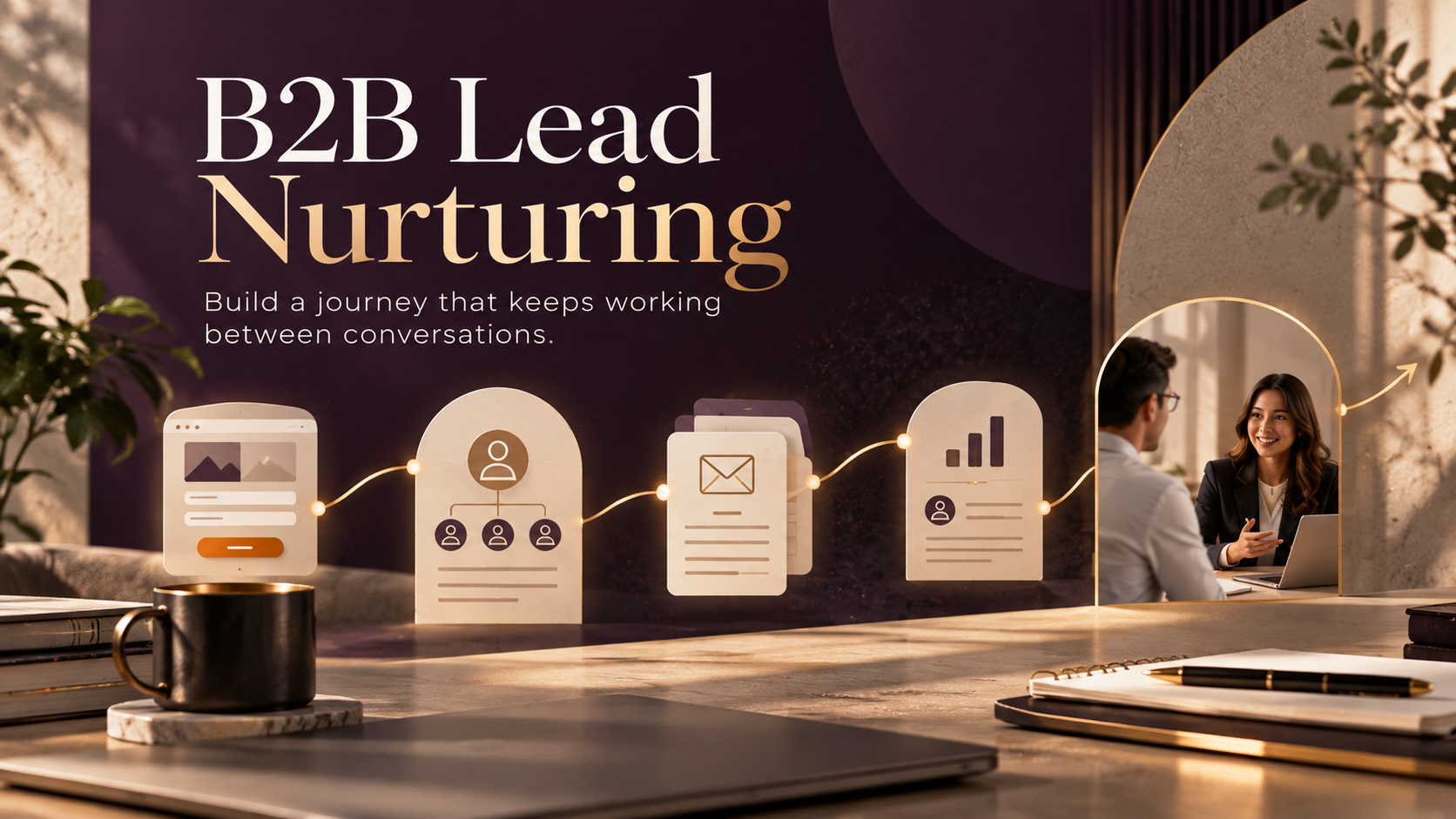
New Lead → Engaged Lead → Qualified Opportunity → Sales Conversation → Proposal → Client
Your stages don’t need to look exactly like this.
They need to reflect how people actually buy from your business.
Then ask:
What does this person need to know before they can comfortably move to the next stage?
Now you’re building a customer journey instead of an email schedule.
Segment Before You Nurture
Imagine you run a professional services firm offering three services.
Someone requests information about Service A.
Another person downloads a guide related to Service B.
Another has already discussed Service C with your sales team.
Putting all three into a generic sequence wastes the information they’ve already given you.
Even basic segmentation can make nurturing significantly more relevant.
You might segment by:
- Service interest
- Lead source
- Lifecycle stage
- Industry
- Company type
- Previous conversation
- Content downloaded
- Website action
- Engagement level
You don’t need 50 segments.
You need enough information to avoid treating every lead like the same person.
This is also why CRM data quality matters so much.
Automation can only make decisions using the information available to it.
If your CRM doesn’t know where a lead came from, what they’re interested in, or whether sales is already talking to them, your automation has very little context.
A Practical B2B Lead Nurturing Journey
Suppose someone visits your website and submits an inquiry about improving their CRM and email automation.
Here’s one way the journey could work.
Step 1: Capture the Lead Properly
The form submission shouldn’t simply arrive in someone’s inbox.
Ideally, it also updates the CRM with useful information:
Contact: Who are they?
Company: Where do they work?
Interest: What are they asking about?
Source: Where did they find you?
Lifecycle stage: Are they a new lead?
Then the system can create the appropriate opportunity, notify the right person and determine what should happen next.
This connects directly with the CRM automation foundation I covered in the previous article.
Automation starts becoming much more useful when one action gives the rest of your system enough context to respond intelligently.
Step 2: Acknowledge the Inquiry
The first automated email doesn’t need to sell anything.
Its job is reassurance.
“We received your message.”
“Here’s what happens next.”
“Here’s when you can expect to hear from us.”
That’s it.
You can also provide something genuinely helpful while they wait.
The important part is that the person doesn’t submit a form and immediately enter a black hole.
Step 3: Let the Human Conversation Happen
This is where some automations go wrong.
The prospect starts speaking with someone from the business, but the nurture sequence keeps running as though nothing happened.
Tuesday:
Thanks for speaking with us.
Wednesday:
Have you considered booking a call?
Thursday:
Here’s why you should book a consultation.
They already did.
Your CRM and nurture automation should communicate with each other.
Once a meaningful sales conversation begins, the generic nurture may need to pause.
That doesn’t mean automation disappears.
It means the automation changes based on the relationship.
Step 4: Nurture the Leads Who Aren’t Ready Yet
Now consider the prospect who says:
“This sounds interesting, but we’re not ready yet.”
This is where nurture becomes valuable.
Instead of repeatedly asking them to schedule another meeting, help them understand the problem they’re trying to solve.
A nurture journey might cover:
Email 1: Clarify the problem
Help them identify why the issue exists.
For CRM automation, that might mean showing the signs that manual follow-up is starting to become a growth problem.
Email 2: Show them what better looks like
Don’t immediately pitch your service.
Explain the process.
What should happen after a website inquiry?
What information belongs in the CRM?
Where should automation help?
Email 3: Help them avoid a mistake
This type of content works well because it’s genuinely useful.
For example:
Five CRM automations I wouldn’t build until the basics are fixed.
You’re demonstrating expertise without needing to say:
“We’re experts.”
Email 4: Provide proof or context
A short example can help.
You don’t need to reveal confidential client information.
You could explain:
I recently worked through a database where the real problem wasn’t that the business needed more automation. The existing contact structure needed to be cleaned up first. Building another workflow on top would only have automated the mess.
That teaches something while showing how you think.
Email 5: Give them an easy next step
Now the CTA makes sense.
Not:
BUY NOW.
Something more natural:
If you’re trying to work out where your own follow-up process is breaking down, we can map it together.
The sales conversation becomes a continuation of the education rather than an abrupt change in tone.
Your Nurture Sequence Should Have Exit Rules
This part gets overlooked surprisingly often.
Businesses spend time deciding how someone enters an automation.
They don’t spend enough time deciding how they leave it.
Let’s say your nurture workflow contains six emails.
After Email 2, the lead books a consultation.
Should Emails 3–6 continue?
Probably not in their original form.
Someone might need to exit or move into another journey when they:
- Book a call
- Become a qualified opportunity
- Receive a proposal
- Become a client
- Unsubscribe
- Enter an active sales conversation
- No longer meet your marketing criteria
I consider this just as important as the email content.
Good lifecycle automation responds when the relationship changes.
Sales and Marketing Need to Share Context
Lead nurturing becomes much stronger when sales and marketing aren’t operating as two separate systems.
Marketing may know:
Which emails the person received.
What content they downloaded.
Which service interested them.
What pages they visited.
Sales may know:
What problem the person actually described.
Their timeline.
Their objections.
Whether there’s an active opportunity.
Their next planned conversation.
Both sides contain useful information.
Your CRM should help bring that context together.
For example, if someone is actively talking with sales, you may want to suppress certain promotional nurture emails.
If an opportunity goes quiet for a defined period, it may make sense to move the contact back into an appropriate nurture journey.
The exact logic depends on the business.
The important part is designing it intentionally.
Don’t Measure Lead Nurturing Only by Open Rate
Open rate can tell you something about an email program, but it shouldn’t be the only definition of success.
For B2B nurturing, I care much more about what happens afterward.
Are people clicking useful resources?
Are leads replying?
Are more nurtured leads booking conversations?
Are dormant opportunities becoming active again?
How many qualified opportunities were influenced by nurture?
Are people progressing through lifecycle stages?
Is sales receiving better-informed prospects?
Is the nurture generating actual pipeline?
Those questions connect marketing activity with business outcomes.
And they help prevent the nurture program from turning into:
“We sent six emails and the average open rate was X.”
That isn’t the full story.
A Simple Lead Nurturing Automation
For a small B2B team, the system does not need to be huge.
It could look like this:
Website inquiry / content conversion
↓
Create or update CRM contact
↓
Record source + service interest
↓
Send acknowledgement
↓
Notify appropriate person
↓
Check: Is there an active sales conversation?
YES → Pause marketing nurture / move to sales journey
NO → Continue
↓
Send educational content based on interest
↓
Check engagement
↓
Send problem/solution content
↓
Check lifecycle stage again
↓
Send proof, example or case study
↓
Offer relevant next step
↓
Continue long-term nurture OR exit
That gives you something far more useful than:
Email 1 → wait → Email 2 → wait → Email 3.
The difference is the decision points.
Where HubSpot, ActiveCampaign and GoHighLevel Fit
You can build this type of nurture system in platforms such as HubSpot, ActiveCampaign, or GoHighLevel.
The exact setup will look different in each platform.
But I wouldn’t choose your nurture strategy based on which workflow builder looks nicest.
Start with the customer journey.
Define:
Who enters?
Why are they entering?
What do we know about them?
What do they need next?
What indicates buying intent?
When should sales become involved?
When should the automation stop?
Then translate that logic into the CRM.
Your strategy should dictate the automation.
Not the other way around.
Common B2B Lead Nurturing Mistakes
A few problems I would look for during an audit:
Sending the same sequence to every lead.
If you already know why someone contacted you, use that information.
Every email asks for a meeting.
If every message says “book a call,” that’s not really nurturing.
Sales activity doesn’t stop marketing automation.
This creates awkward customer experiences quickly.
No exit criteria.
People stay inside workflows long after their situation changes.
Too many emails without enough value.
More touchpoints don’t automatically create more trust.
Measuring activity instead of progression.
Email sends aren’t the objective. Moving appropriate prospects forward is.
Automating before cleaning the CRM.
If your lifecycle stages, contact data and segmentation are unreliable, fix those foundations first.
What I Would Build First
If you’re starting B2B lead nurturing from scratch, don’t begin with a 20-workflow lifecycle architecture.
Pick one meaningful audience.
For example:
Qualified website leads who expressed interest but didn’t book a consultation.
Map what happens to those people today.
Then identify the gap.
Build a short journey around that gap.
Watch what happens.
Talk to sales.
Improve it.
Once that journey works, build the next one.
That approach may feel slower than creating ten automations at once.
In practice, it usually produces a system that’s much easier to understand, maintain and improve.
And that’s the point.
A lead nurturing system shouldn’t exist so you can say your business has marketing automation.
It should make the experience between “I’m interested” and “I’m ready to talk” genuinely more useful.
When Your Leads Are Coming In but the Journey Afterward Feels Unclear
You may not need more leads yet.
You may need to see what happens to the leads you already have.
At Marvz Solutions, I help small B2B teams connect the pieces between their website, CRM, email marketing and automation so follow-up doesn’t depend entirely on someone remembering what to do next.
The first step isn’t necessarily building anything.
It’s understanding where the journey currently breaks.
From there, we can decide what actually needs fixing.
FAQ
What is B2B lead nurturing?
B2B lead nurturing is the process of building and maintaining a relevant relationship with potential business customers who are not yet ready to buy. It can combine email, CRM data, sales follow-up, useful content and marketing automation.
How many emails should a B2B nurture sequence have?
There isn’t a universal number. The right length depends on the buying journey, lead intent and purpose of the sequence. Start by defining what the prospect needs and the conditions that should move them forward or remove them from the automation rather than choosing an arbitrary number of emails.
What is the difference between lead nurturing and email marketing?
Email marketing is a communication channel. Lead nurturing is a broader strategy for helping potential customers progress through a buying journey. Email can support that strategy alongside CRM segmentation, sales activity, website behavior and automation.
When should a lead leave a nurture sequence?
Common exit conditions include booking a sales conversation, becoming an active opportunity, purchasing, unsubscribing or no longer meeting the criteria for the journey. Exit rules should be defined before the workflow goes live.
Can small B2B businesses use lead nurturing?
Yes. A small business can start with one focused journey for a high-value lead segment rather than building a complicated lifecycle program immediately.